Enterprise Servers and Storage Solutions for UAE Data Centres and Private Clouds
VertiLinks Technologies is an authorised partner for Dell EMC and HPE, supplying PowerEdge and ProLiant servers, Dell EMC PowerStore, PowerVault, and Unity XT storage arrays, and HPE Primera, Nimble, and StoreEasy platforms for data centres, colocation facilities, and on-premise IT infrastructure across the UAE and GCC. Since 2024, VertiLinks has deployed server and storage infrastructure for financial institutions, government agencies, healthcare providers, logistics operators, and retail chains — building the compute backbone that powers the UAE's digital economy.
Enterprise server and storage infrastructure decisions are long-cycle investments with 5–7 year operational lifespans. Getting the architecture right at deployment time is critically important — undersizing leads to emergency capacity expansions at premium cost, while oversizing wastes capital that could fund other IT initiatives. VertiLinks brings a structured approach to server and storage design: workload profiling, performance modelling, failure mode analysis, and total cost of ownership comparison across competing platforms. Our design methodology is workload-first, not brand-first — we specify the platform that best fits your workload characteristics, budget, and operational model, whether that is a Dell or HPE product or a combination of both.
Dell PowerEdge Servers: Architecture and Key Models
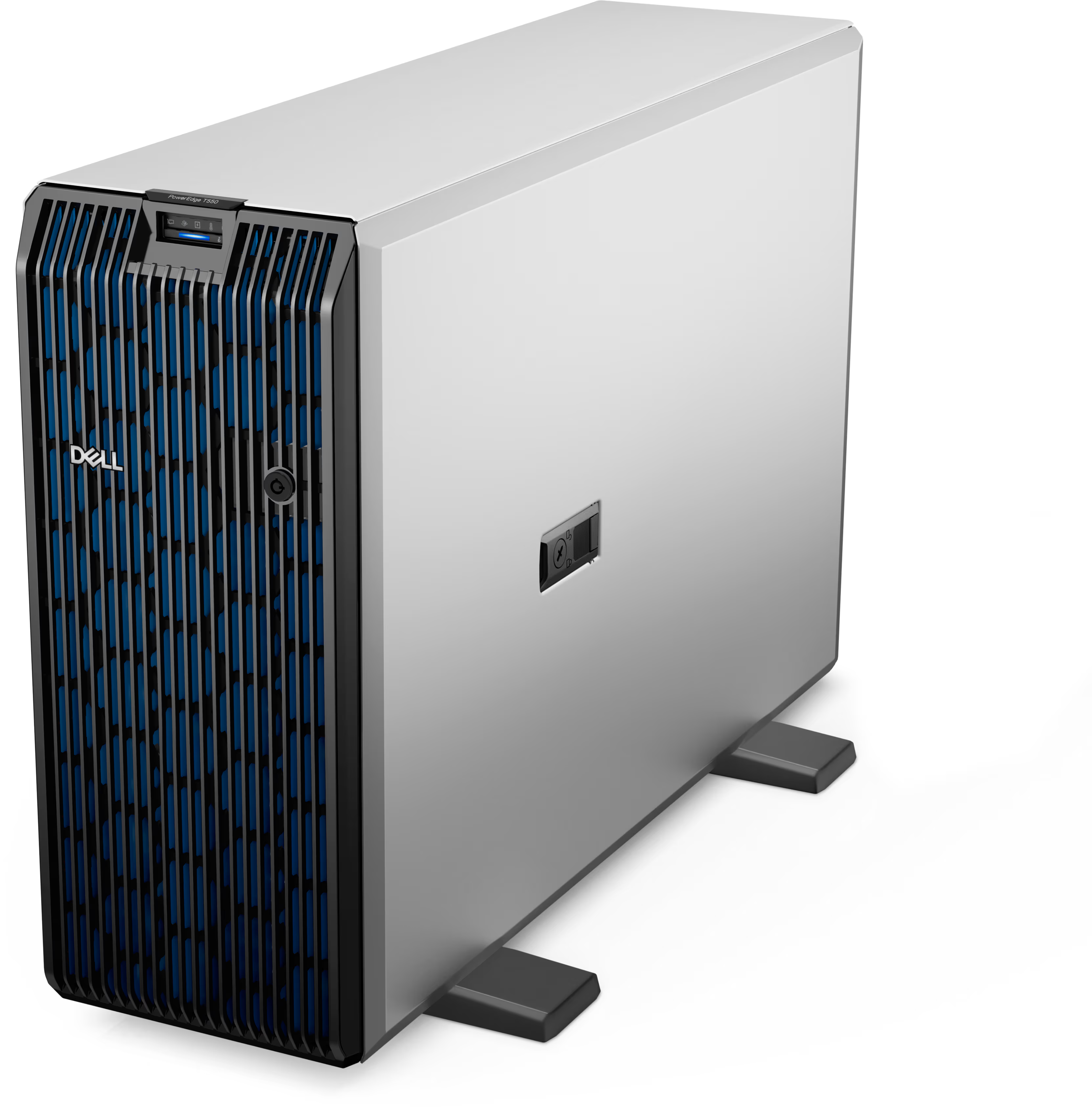
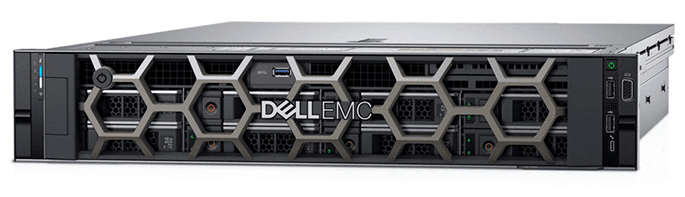
The Dell PowerEdge 16th generation server portfolio (PowerEdge R760, R660, R560, R460, and their storage-dense variants) is built on Intel Xeon Scalable (Sapphire Rapids) and AMD EPYC (Genoa) processors, supporting up to 8TB of DDR5 ECC RAM per server, PCIe Gen 5 expansion for NVMe SSDs and GPU accelerators, and 25GbE/100GbE network connectivity. The PowerEdge iDRAC9 Enterprise management controller provides secure remote access to server console, power management, firmware updates, and hardware health monitoring completely independently of the server OS — enabling full remote management without physical data centre access, particularly valuable for UAE organisations with IT staff in Dubai managing servers in Abu Dhabi or overseas colocation facilities.
Dell's OpenManage portfolio integrates PowerEdge servers with VMware vCenter, Microsoft SCVMM, and Ansible automation frameworks, enabling infrastructure-as-code server deployment where a new server boots, downloads its configuration from a management server, and installs its intended OS and application without any manual intervention — reducing server deployment time from days to hours and eliminating configuration inconsistencies across large server fleets.
HPE ProLiant Servers: Reliability and the iLO Management Engine
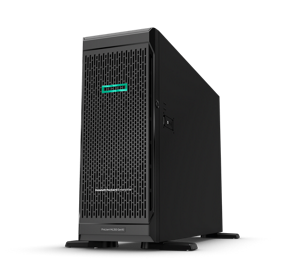
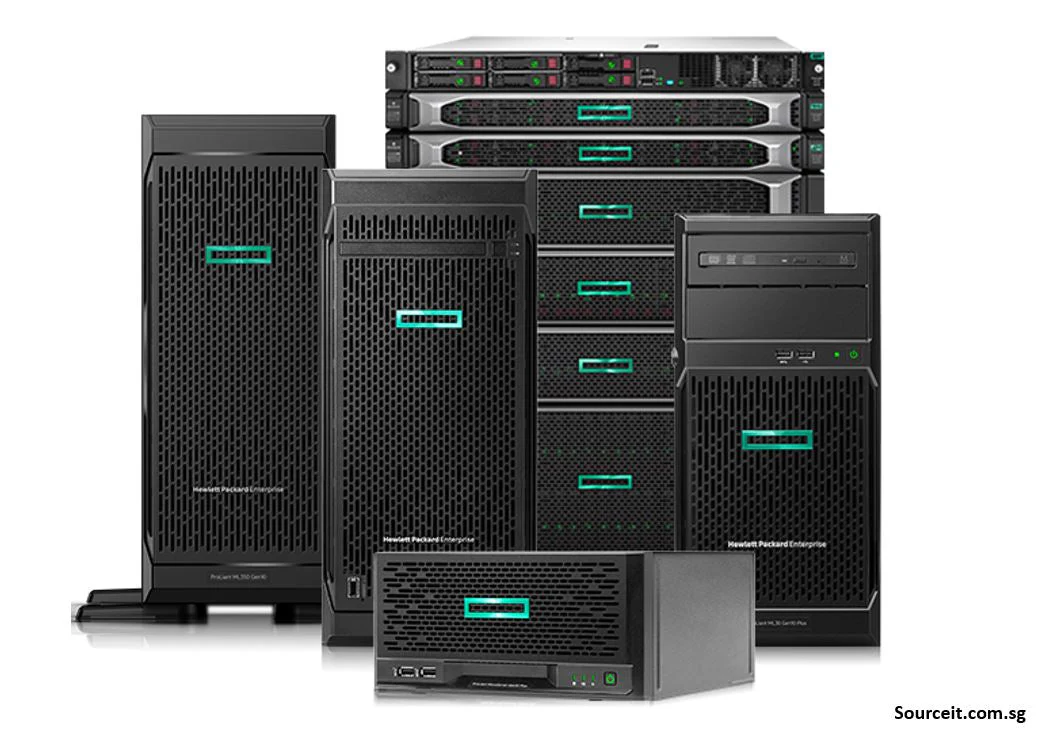
HPE ProLiant servers (DL360 Gen11, DL380 Gen11, DL560 Gen11, and ML350 Gen11 tower) compete directly with Dell PowerEdge across all form factors and workload categories. HPE's differentiation centres on the iLO (Integrated Lights-Out) management engine, which HPE positions as the industry's most mature server management interface, and on Silicon Root of Trust — a hardware-level security architecture where the iLO firmware is cryptographically signed and verified against an immutable root stored in the silicon during manufacturing. Any tampering with iLO firmware — including sophisticated supply-chain attacks — is detected and the server refuses to boot, providing protection that goes beyond what software-based security tools can offer.
HPE's Compute Ops Management cloud platform (formerly iLO Amplifier Pack) provides a unified management console for ProLiant servers across multiple sites, with automated firmware compliance checking, one-click firmware updates across server groups, and AI-driven predictive failure analysis that identifies hardware components approaching failure before they cause outages. For organisations with small IT teams managing distributed server infrastructure across multiple UAE sites, HPE's centralized management capabilities reduce administrative overhead significantly.
Storage Solutions: SAN, NAS, and HCI
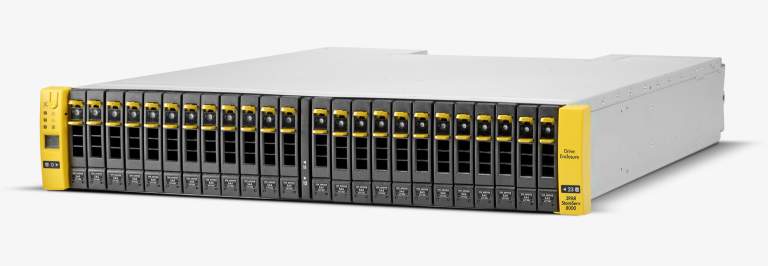
All-flash NVMe storage arrays deliver latency of 100–500 microseconds — one to two orders of magnitude lower than traditional HDD-based SAN arrays — enabling database response times, virtual desktop login times, and transaction processing speeds that drive measurable business outcomes. The Dell EMC PowerStore 1000T and 3000T are VertiLinks' most frequently deployed all-flash platforms for UAE database and virtualisation environments, offering inline data reduction (deduplication plus compression) ratios of 4:1 to 6:1 that typically reduce effective per-TB cost to levels competitive with hybrid storage arrays, while delivering performance that hybrid arrays cannot approach.
NAS (Network-Attached Storage) platforms serve file sharing, home directories, content repositories, and backup targets across standard network protocols (SMB/CIFS, NFS, iSCSI). Dell EMC PowerVault NAS and HPE StoreEasy series provide integrated Windows Storage Server or HPE OS-based NAS with global deduplication, snapshot-based recovery, and seamless integration with Microsoft DFS (Distributed File System) for transparent multi-site file access. For organisations with large unstructured data volumes — media assets, engineering CAD files, medical imaging archives — NAS platforms with tiered storage policies automatically migrate older, less-accessed data from expensive flash to cost-effective high-capacity HDDs, optimising storage costs without manual data management.
Hyper-Converged Infrastructure (HCI) collapses compute, storage, and networking into a single appliance architecture, managed through a unified software platform. Dell EMC VxRail (built on VMware vSAN) and HPE SimpliVity are the leading HCI platforms in the UAE enterprise market. HCI eliminates the traditional three-tier architecture (server + SAN switch + storage array) in favour of a software-defined approach where storage is distributed across the NVMe drives in each compute node, with data replication providing resilience without dedicated storage hardware. The capital cost of HCI is typically 20–30% lower than equivalent three-tier infrastructure, and operational complexity is dramatically reduced — VMware vSAN or HPE SimpliVity manages all storage operations automatically, without the manual volume creation, zoning, and LUN mapping required in traditional SAN environments.