Access control is one of the most important parts of a modern workplace security strategy. Businesses need to know who can enter a building, which areas they can access and when they are allowed to enter.
Traditional keys and basic access systems can become difficult to manage as organisations grow. Employees change roles, visitors arrive, contractors need temporary access and security teams need accurate records of access events.
A modern access control system brings these activities together. With access control software, businesses can manage users, permissions, doors, credentials, schedules and security events from a central platform.
What Is an Access Control System?
An access control system is a combination of hardware and software used to control entry to buildings, rooms, zones and other secured areas.
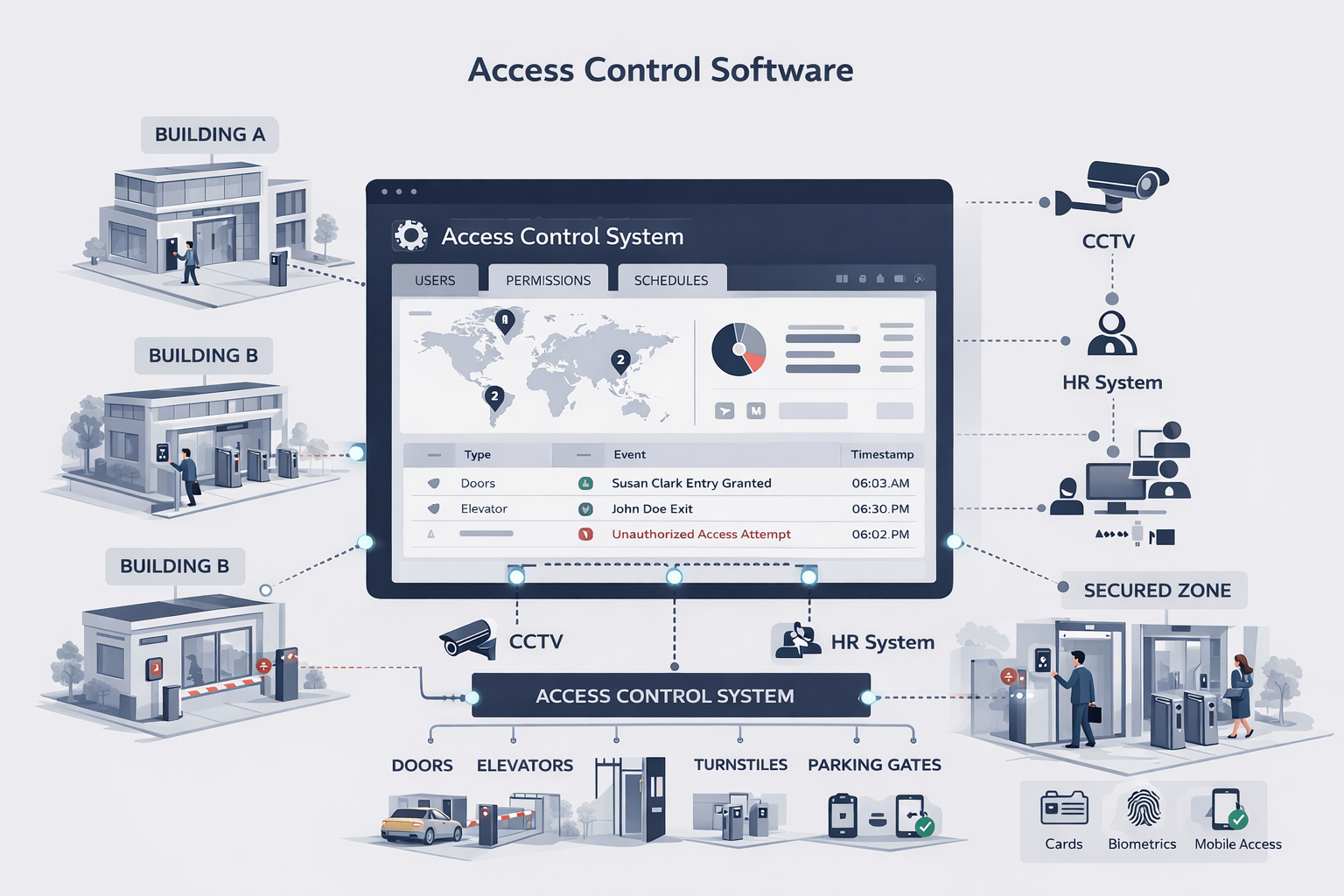
The hardware may include card readers, biometric devices, controllers, turnstiles, elevator controls and other entry equipment. The software provides the management layer where security teams can create users, assign permissions, monitor events and review access records.
Modern access control management software can also connect with CCTV, visitor management, HR platforms and building management systems. This creates a more connected security environment.
Why Businesses Need Smarter Access Control
A business may have different access requirements for employees, managers, contractors, visitors and security staff. Giving everyone the same access can create unnecessary security risks, while managing every door manually can create a large administrative workload.
A well-designed access control solution helps businesses apply access rules based on role, location and time.
- Employees can receive access based on their role
- Restricted areas can be limited to authorised users
- Temporary access can be created for visitors and contractors
- Access permissions can be changed when an employee changes roles
- Security teams can monitor access events in real time
- Access logs can support investigations and audits
- Multiple locations can be managed from a central platform
Centralised Access Control Management
One of the biggest advantages of modern access control software is centralised management. Instead of checking separate systems for different doors or buildings, security administrators can use one platform to manage access points across an organisation.
A central dashboard can provide information about door status, access events, alerts and user permissions. This can make daily security operations easier and help teams respond more quickly when an unusual event occurs.
For organisations with multiple offices or facilities, centralised management can also make it easier to apply consistent security policies across locations.
Key Features of Access Control Software
User and Permission Management
Administrators can create user profiles and assign access permissions based on departments, roles or security requirements. Permissions can also be updated when responsibilities change.
Biometric and Smart Credentials
Depending on the deployment, businesses can use RFID cards, PINs, biometric credentials or compatible mobile credentials. Different credential types can support different security and convenience requirements.
Time-Based Access Rules
Access does not always need to be available 24 hours a day. Access control management software can allow businesses to define schedules, zones, holiday exceptions and other rules.
Real-Time Event Monitoring
Security teams can monitor events such as authorised entry, denied access, forced entry alerts and doors being held open. When integrated with compatible CCTV systems, access events can also be supported by video verification.
Visitor and Temporary Access
Visitors, contractors and delivery personnel may need access for a limited period. Temporary credentials and expiry rules can reduce the need to create permanent access permissions.
Reporting and Audit Records
Access logs can help businesses understand who entered a particular area and when. Reports can support security reviews, investigations and internal audit requirements.
How Access Control Connects With Other Systems
Access control becomes more useful when it works with other business and security systems. For example, a visitor management system can send approved visitor information to the access control platform. CCTV security systems can provide video context for access events. HR systems can help keep employee records and access permissions aligned.
VertiLinks' access control software supports integrations with compatible CCTV and VMS platforms, HR systems, visitor management, fire alarm systems, building management systems and directory services. Specific integrations depend on the hardware, software and deployment requirements.
Access Control and Employee Attendance
Access control and employee attendance are different systems, but they can work together.
Access control determines whether a person is allowed to enter a particular area. Attendance management software records employee working time and related information. When these systems are integrated correctly, businesses can reduce duplicate data entry and gain a more complete view of workplace activity.
For example, an employee may use a biometric terminal to record attendance while the same organisation uses access control software to manage entry to secure areas. The systems can serve different purposes while working as part of a connected workplace environment — see also our guide to biometric attendance systems in the UAE.
Access Control for Different Types of Businesses
Access requirements vary depending on the type of organisation.
- Corporate offices may need employee access, visitor management and restricted meeting or server areas.
- Industrial facilities may require stronger controls around production areas, warehouses and equipment.
- Government organisations may need detailed access permissions and audit records.
- Commercial buildings may need access management across offices, shared facilities and parking areas.
- Large campuses may need centralised management across multiple buildings and security zones.
How to Choose the Right Access Control Solution
The right access control system should match the organisation's current requirements while leaving room for future growth.
- Define the areas that need access control. List doors, buildings, elevators, parking areas and restricted zones.
- Identify user groups. Consider employees, managers, contractors, visitors and security personnel.
- Choose appropriate credentials. Decide whether cards, PINs, biometrics or mobile credentials are suitable.
- Check integration requirements. Review CCTV, HR, visitor management, fire alarm and BMS integrations if required.
- Review monitoring and alerts. Security teams should be able to identify important events quickly.
- Check reporting capabilities. Access logs and reports should be easy to search and export.
- Consider scalability. The system should support additional users, doors and locations as the organisation grows.
- Plan for security and privacy. Access information should be protected and available only to authorised users.
Why Software Matters as Much as Hardware
Access readers and controllers are visible parts of an access control installation, but software determines how effectively the organisation can manage them.
Without good access control software, security teams may still need to work with multiple interfaces, manual records and limited reporting. A central platform can bring users, permissions, schedules, alerts and access history together.
This is particularly important for organisations that operate across multiple locations. Centralised software can provide a consistent way to manage access policies without requiring separate processes for every building.
A More Connected Approach to Workplace Security
Modern workplaces increasingly connect physical security with business systems. Access control can work alongside visitor management, attendance, CCTV, HR and building systems to create a more coordinated environment.
The goal is not simply to add more technology. The goal is to make security easier to manage, improve visibility and give authorised people the right access at the right time.
For UAE and GCC businesses, a scalable access control management solution can support this approach while allowing organisations to expand their security infrastructure as their requirements change.
Conclusion
A secure access control system should do more than open and close doors. It should help businesses manage identities, permissions, schedules, visitors and security events in a controlled and efficient way.
Access control software provides the central management layer that makes this possible. When it is integrated with CCTV, visitor management, HR and other systems, businesses can build a more connected approach to workplace security.
VertiLinks provides access control software for UAE organisations with features for centralised access management, credentials, schedules, real-time monitoring, visitor access and reporting. Businesses can choose a deployment based on their building, workforce and security requirements — or contact VertiLinks to plan a site survey.
Frequently Asked Questions
Everything you need to know before making a decision.