
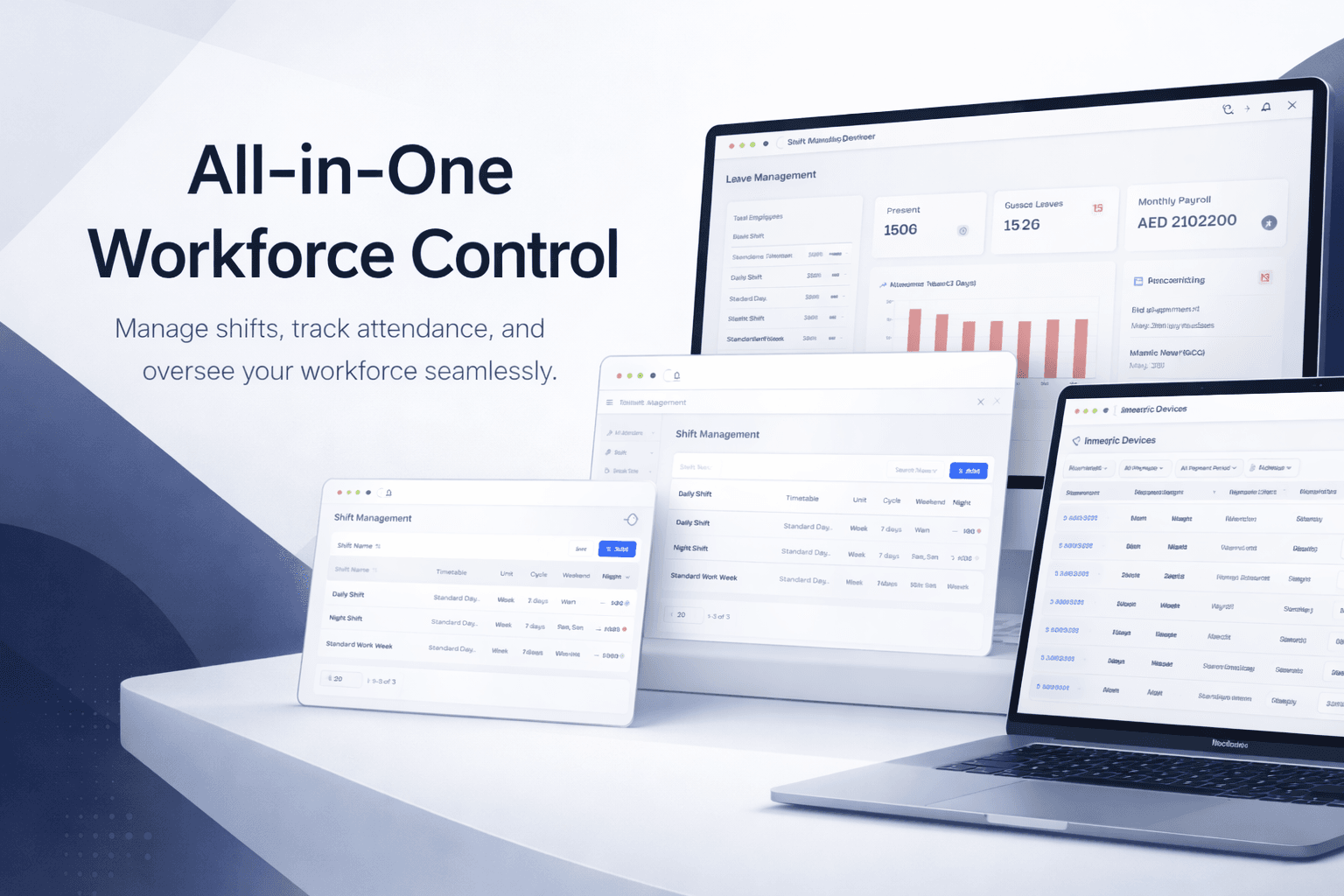
Biometric attendance has become a practical option for businesses that need accurate employee time tracking and better control over attendance data. Fingerprint, facial recognition, palm vein and other biometric methods can reduce manual work and make it harder to record attendance on behalf of another employee.
For UAE businesses, however, choosing a biometric system should not be based on technology alone. Companies also need to think about privacy, data security, employee communication and how the system will be used in day-to-day operations.
The right approach is to balance security and efficiency with responsible handling of personal data. This is where modern time attendance software can make a difference by bringing biometric attendance, shifts, leave, overtime and reporting into one managed system.
What Is a Biometric Attendance System?
A biometric attendance system records an employee's attendance using a physical or behavioural characteristic that can help verify their identity. Common examples include fingerprints, facial recognition and palm vein recognition.
Instead of relying only on paper registers, cards or manual spreadsheets, the system can connect attendance devices with attendance management software. This allows clock-in and clock-out information to be collected automatically and then used for working-hour calculations, leave records, overtime and reports.
Modern attendance management system software can also connect with HR and payroll platforms. This reduces repetitive data entry and gives HR teams a clearer view of workforce attendance.
Why UAE Businesses Are Moving Towards Biometric Attendance
Many businesses in the UAE operate with large teams, multiple shifts or employees working across different locations. Manual attendance processes can become difficult to manage as the workforce grows.
A biometric attendance solution can help businesses:
- Record employee clock-in and clock-out automatically
- Reduce attendance errors caused by manual entry
- Make it more difficult for employees to record attendance for someone else
- Track shifts, overtime and working hours
- Simplify leave and absence management
- Give HR teams real-time attendance information
- Create reports that can support payroll and workforce planning
VertiLinks' attendance management platform supports biometric terminal integration and provides features for attendance, shifts, leave, overtime, reporting and payroll-related workflows for businesses in the UAE and GCC.
Security Should Be More Than a Biometric Device
Buying a fingerprint or facial recognition terminal is only one part of an attendance project. The software and data environment behind the device are equally important.
A good attendance management program should provide controlled access to employee information, clear user permissions, reliable data transmission and useful audit information. HR managers should be able to see who can access attendance data and what actions are being performed within the system.
Businesses should also consider where attendance information is stored, how it is transferred, how long it is retained and how access is protected. These questions become especially important when biometric information is involved.
Privacy and Ethics Matter in Biometric Attendance
Biometric information is closely connected to an individual's identity. Employees may therefore have reasonable questions about why their biometric information is being collected and how it will be used.
The UAE Personal Data Protection Law provides a framework for protecting personal data and regulating its processing. UAE legislation also defines biometric data in relation to physical, physiological or behavioural characteristics that can be used to identify or confirm an individual.
For businesses, this means a biometric attendance project should be planned with privacy and data protection requirements in mind. The exact legal requirements can depend on the organisation, the data involved and the way the system is deployed, so businesses should obtain appropriate legal or privacy advice for their specific situation.
How Businesses Can Use Biometrics Responsibly
A responsible implementation does not need to be complicated. The most important step is to make the purpose of the system clear.
- Explain to employees why biometric attendance is being introduced
- Collect only the information needed for the stated purpose
- Restrict access to attendance and employee data
- Use appropriate technical and organisational security controls
- Define retention and deletion practices
- Review third-party integrations and data flows
- Give employees clear information about how their data is handled
Good communication can also improve adoption. Employees are more likely to accept a new attendance management solution when they understand what the system does and why the business is using it.
The Role of Time Attendance Software
A biometric device can capture an attendance event, but the business usually needs much more than that. Time attendance software turns attendance events into useful workforce information.
For example, a complete attendance management software platform can help HR teams manage:
- Employee clock-in and clock-out records
- Shift schedules and roster planning
- Leave and absence requests
- Overtime calculations and approvals
- Attendance reports and analytics
- Payroll data preparation
- Multi-location workforce management
This gives businesses a central place to manage attendance instead of depending on separate spreadsheets and disconnected systems.
Choosing the Right Attendance Management Solution in UAE
Not every attendance management solution will suit every organisation. Businesses should start with their operational requirements rather than choosing a system based only on the biometric device.
- Check biometric compatibility. Make sure the software works with the biometric terminals your business uses or plans to install.
- Review workforce requirements. Consider shifts, locations, employee numbers, overtime rules and leave policies.
- Check integrations. If attendance data needs to reach an HR or payroll platform, confirm that the required integration is available.
- Review security controls. Ask how employee and biometric-related data is protected and who can access it.
- Consider scalability. The attendance management program should continue to work as the business adds employees or locations.
- Look at reporting. HR teams should be able to generate useful reports without relying on manual spreadsheet work.
- Plan the implementation. Device installation, employee enrolment, software configuration and training should be treated as one project.
Innovation Without Losing the Human Side
Innovation is useful when it solves a real business problem. Biometric attendance can improve accuracy and reduce administrative work, but technology should not replace responsible management.
Businesses should use attendance information to improve workforce planning and operational efficiency rather than creating unnecessary monitoring. Clear policies, limited access and transparent communication can help maintain trust while still giving organisations the benefits of automation.
As attendance management software becomes more connected with HR, payroll, access control and other business systems, the value of a well-planned platform will continue to grow.
Conclusion
Biometric attendance systems can help UAE businesses improve attendance accuracy, reduce manual work and gain better workforce visibility. But the best system is not simply the one with the most advanced biometric technology.
Businesses should look at the complete attendance management solution, including security, privacy, software capabilities, integrations and employee communication. With the right approach, biometric attendance can support both operational efficiency and responsible data management.
For organisations looking to modernise employee attendance, VertiLinks provides attendance management software with biometric integration, workforce tracking, shift management, leave management, reporting and payroll-related capabilities for UAE and GCC businesses. You can also explore our guide to a secure access control system or contact our team for a tailored recommendation.
Frequently Asked Questions
Everything you need to know before making a decision.